When Good Intentions Go Wrong: The Real Risks of Handling HVAC Repairs Yourself
The Appeal of the DIY Approach—And Why It Breaks Down Quickly
In an era when tutorial videos and home improvement guides are readily available at the touch of a screen, it is easy to understand why homeowners and business owners alike are tempted to take HVAC matters into their own hands. A unit that stops cooling, a thermostat that behaves erratically, or a system that produces unusual sounds can all seem like problems with obvious solutions. The logic is straightforward: watch a video, follow the steps, and avoid paying a service call fee.
The reality, however, is considerably more complicated. Modern HVAC systems are sophisticated assemblies of mechanical, electrical, and chemical components that interact in ways that are not always visible to the untrained eye. What appears to be a simple fix often involves variables that only a licensed technician is equipped to assess. And when those variables are misread or ignored, the cost of correction frequently exceeds what a professional service call would have cost from the start.
Refrigerant Handling: A Serious Legal and Health Concern
One of the most common areas where DIY attempts go wrong involves refrigerant—the chemical compound responsible for the cooling cycle in your air conditioning system. Many homeowners assume that a warm-blowing unit simply needs a refrigerant "top-off," a task they believe can be handled with a kit purchased at a hardware store.
This assumption carries significant consequences. Under Section 608 of the Clean Air Act, the purchase and handling of certain refrigerants—including R-410A, which is standard in most modern residential systems—is regulated by the U.S. Environmental Protection Agency. Technicians must hold EPA Section 608 certification to legally purchase and work with these substances. Improper handling can result in federal fines, but more immediately, it poses direct health risks including skin burns, respiratory irritation, and in enclosed spaces, oxygen displacement.
Beyond the legal and health dimensions, adding refrigerant to a system without first identifying and repairing the source of a leak accomplishes nothing of lasting value. Refrigerant does not deplete through normal operation—if levels are low, a leak exists somewhere in the system. A certified technician will locate and seal that leak before recharging the system, ensuring the repair addresses the actual problem rather than masking it temporarily.
Electrical Hazards That Are Easier to Create Than to Anticipate
Air conditioning systems operate on voltages that can cause serious injury or death. Outdoor condensing units, air handlers, and associated wiring involve components that remain energized even when a thermostat is switched off. Many homeowners are unaware that capacitors—cylindrical components inside the condenser unit—store electrical charge and can discharge with lethal force even after the system's power supply has been disconnected.
DIY electrical work on HVAC systems also creates conditions that may not manifest as immediate failures. Loose connections, improperly sized fuses, or wiring that bypasses safety controls can allow a system to operate in a degraded state for weeks or months before causing a fire, a compressor failure, or a complete electrical fault. These are scenarios that a trained technician's diagnostic process is designed to catch and correct before they escalate.
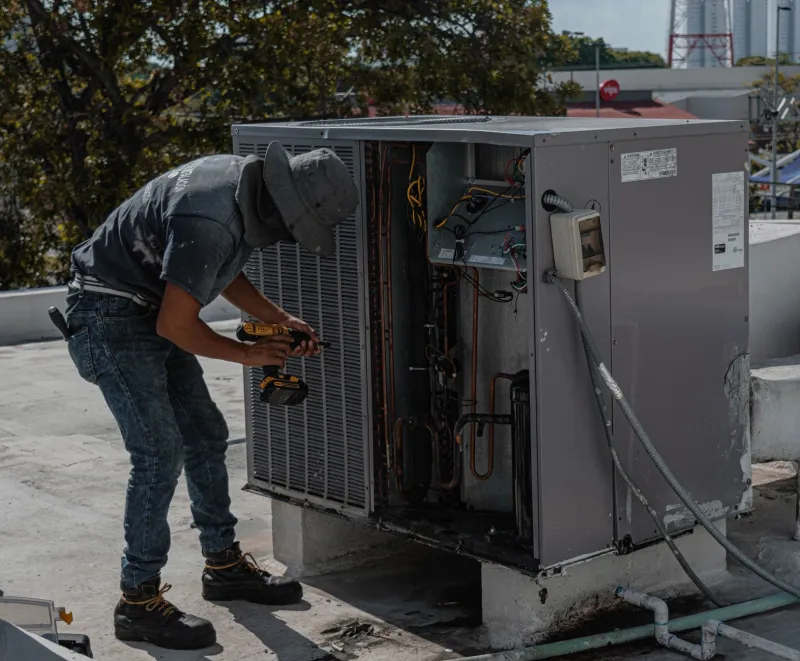
In commercial settings, the stakes are compounded by the scale of the equipment and the occupancy of the space. A wiring error in a rooftop commercial unit can disrupt operations, trigger code violations, and in worst-case situations, create life-safety hazards for building occupants.
Warranty Voidance: The Hidden Financial Consequence
Most HVAC manufacturers include explicit language in their warranty agreements requiring that installation, maintenance, and repair work be performed by licensed professionals. This requirement is not incidental fine print—it is a condition that, when violated, nullifies the warranty entirely.
Consider the financial exposure this creates. A residential central air conditioning system represents an investment that can range from several thousand to tens of thousands of dollars depending on system size and configuration. A compressor replacement alone—one of the most common major repairs—can cost between $1,500 and $2,500 or more. Under a valid manufacturer's warranty, that cost may be covered in part or in full. Under a voided warranty, the entire expense falls to the property owner.
The scenario plays out with troubling regularity: a homeowner attempts a minor repair, inadvertently damages a related component, and discovers upon calling a professional that the warranty no longer applies. The money saved on the initial service call is dwarfed by the cost of repairs that warranty coverage would otherwise have absorbed.
Misdiagnosis: Fixing the Wrong Problem at the Right Price
Even setting aside safety and legal considerations, DIY HVAC repairs frequently fail because the underlying diagnosis is incorrect. HVAC systems are designed to exhibit symptoms—unusual sounds, reduced airflow, inconsistent temperatures—but those symptoms rarely point to a single, obvious cause. A system that short-cycles, for example, might be responding to a dirty air filter, a refrigerant imbalance, an oversized unit, a failing capacitor, or a malfunctioning thermostat. Each of those causes requires a different corrective action.
Without diagnostic tools and the training to interpret their readings, it is easy to replace a component that did not need replacing while leaving the actual source of the problem unaddressed. This results in wasted expenditure on parts, continued system degradation, and eventually a service call that now involves diagnosing not only the original issue but also the consequences of the attempted repair.
What Professional Service Actually Provides
A licensed HVAC technician brings more than a set of tools to a service call. They bring EPA certification for refrigerant handling, familiarity with manufacturer specifications, access to professional-grade diagnostic equipment, and the experience to recognize failure patterns that are not immediately apparent. They also carry liability coverage, meaning that if something goes wrong in the course of their work, there is a professional framework in place to address it.
At Mast Air Conditioning, every service visit is approached as an opportunity not just to fix the presenting issue but to assess the overall condition of the system. That broader evaluation frequently surfaces developing problems that, addressed early, prevent the kind of catastrophic failures that leave residential and commercial clients without climate control during the hottest or coldest periods of the year.
Professional HVAC service is not simply a convenience—it is a form of protection for your equipment investment, your property, and the people who occupy it.
The Smarter Calculation
The decision to call a professional rather than attempt a repair independently is not a concession—it is a calculation that favors long-term value over short-term savings. When the full picture is considered—warranty integrity, safety exposure, accurate diagnosis, and the cost of compounding errors—professional service consistently proves to be the more economical path.
If your system is exhibiting signs of trouble, the right first step is a call to a qualified technician. The risks of proceeding otherwise are simply not worth the temporary savings.


